
Project 011—How to Draft a Pajama Pants Block
In this post, I'll show you how to draft a basic trouser/pants block to use for making your own pajama pants.

Welcome to Sewing With Numbers, a newsletter about sewing, math, design and how to draft your own sewing patterns. Through simple pattern drafting exercises, I’ll show you how fun, useful and empowering math can be. ✂️ Posts older than 3 months are archived for paid subscribers. But if subscriptions aren’t your thing, I also have PDF Booklets for older projects in my shop.
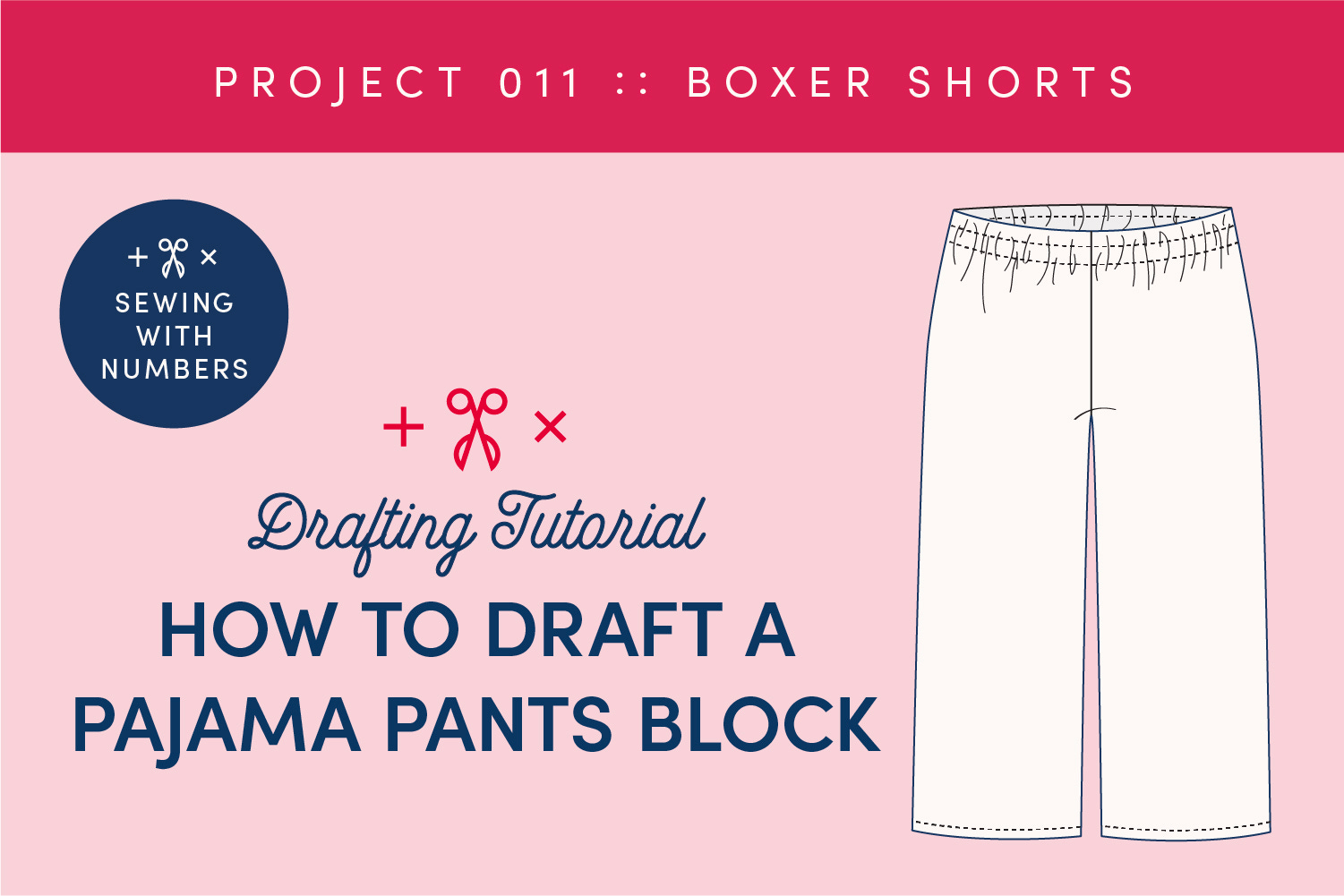
Today, I’m sharing the first tutorial for Project 011 Boxer Shorts. If you missed the intro post, you can read it here. You might be thinking, why are we doing full length pants when our goal is shorts? In short (lol), I want to start with a block that has balance lines and all the markings that we need for fitting. So, even though our goal is an oversized fit, we’ll start with a more fitted block and then add ease.
The block we’re creating today is for elastic waist woven pants, which I’m calling Pajama Pants. You could, of course, use this block for any elastic waist woven pants. For this tutorial, I’m mostly relying on the book How to Make Sewing Patterns by Donald H. McCunn. I’ve included additional resources at the end of the post.
This tutorial is in four parts:
Part 1: Gather Information
Part 2: Draft the Front Pant Block
Part 3: Draft the Back Pant Block
Part 4: Adjust/Finalize the Block
How to Draft an Elastic Waist (Pajama) Pant Block
Part One: Gather Information
I’ve assigned a representative letter to each number we’ll need. I’ll use these letters to write the drafting formulas. When drafting your block, you’ll replace the letters with your own numbers.
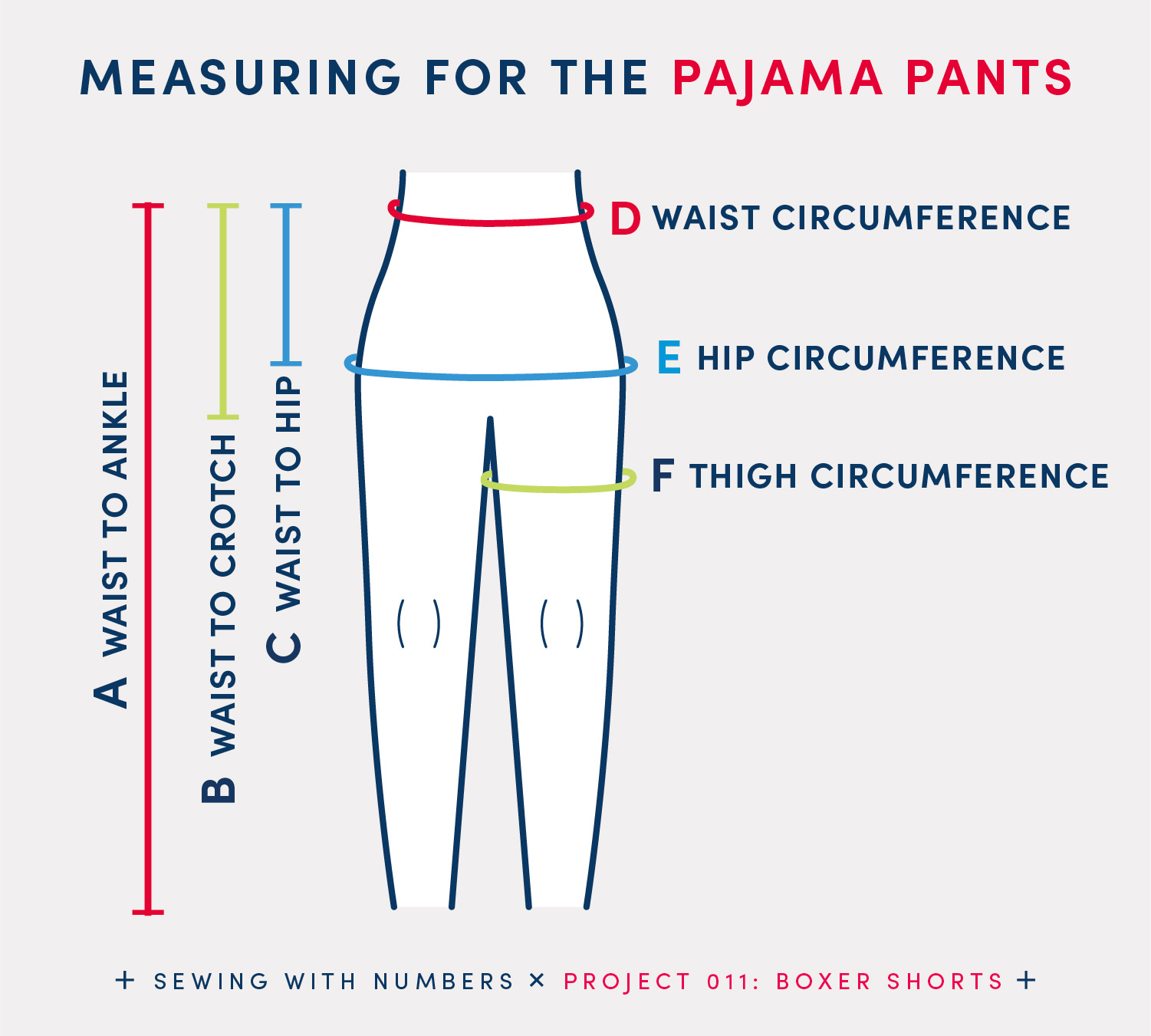
For this block, you need to take a few body measurements. First, decide where on the body you want the waistline of the pants to sit. This may or may not be the natural waist. From this point, measure the length from the waist to the ankle, crotch and hip points. (You can also measure Waist to Knee and add that line to your block. This point is especially helpful if you want to make a shaped pant leg.) To take these measurements, you can tie a pieces of elastic around the waist and hip points, then use a flexible measuring tape to measure the length.
Finally, measure the circumference of the waist (at the desired waist point), the hips and the top of the thigh.

A Waist to Ankle Measure from the desired waist point to the ankle (or even the floor). See graphic above.
B Waist to Crotch Measure from the desired waist point to the bottom of the crotch. See graphic above.
C Waist to Hip Measure from the desired waist point to the hip point (the fullest part of the hips). See graphic above.
D Waist Circumference Measure the body circumference where you want the waist of the pants to sit. This may or may not be the “natural” waist. See graphic above.
E Hip Circumference Measure the circumference of the largest part of the hips. See graphic above.
F Thigh Circumference Measure the circumference of the largest part of the thigh (usually at the top). See graphic above.
G Ease at Hip This is designer’s choice. For this style of woven pants, we need to have positive ease. I like to have about 4-6” (10-15cm) of positive ease. You can measure a pair of pants that you like to see how much ease you want. As a reminder, Ease = Finished Garment Measurement — Body Measurement. If your waist measurement is larger than your hip measurement, you can think of this as how much ease you want at the waist.
H Seam allowance Designer’s choice.
I Hem allowance Designer’s choice.
Part Two: Draft the Front Pant Block
We’re going to start drafting the block with the length measurements. This initial line that we draw is the Leg Centerline. It’s also called the Crease Line or the Grainline. You can use this line when fitting to ensure that the pants are hanging straight down from the waist.
It’s also important to note that this initial block does not have ease. Normally, blocks are built with ease included. But because we intend to add extra ease for the elastic waist style, I’ve decided to add all of the ease at the end. So, just be aware that this is simplified from most drafting because the elastic waist style is more forgiving.
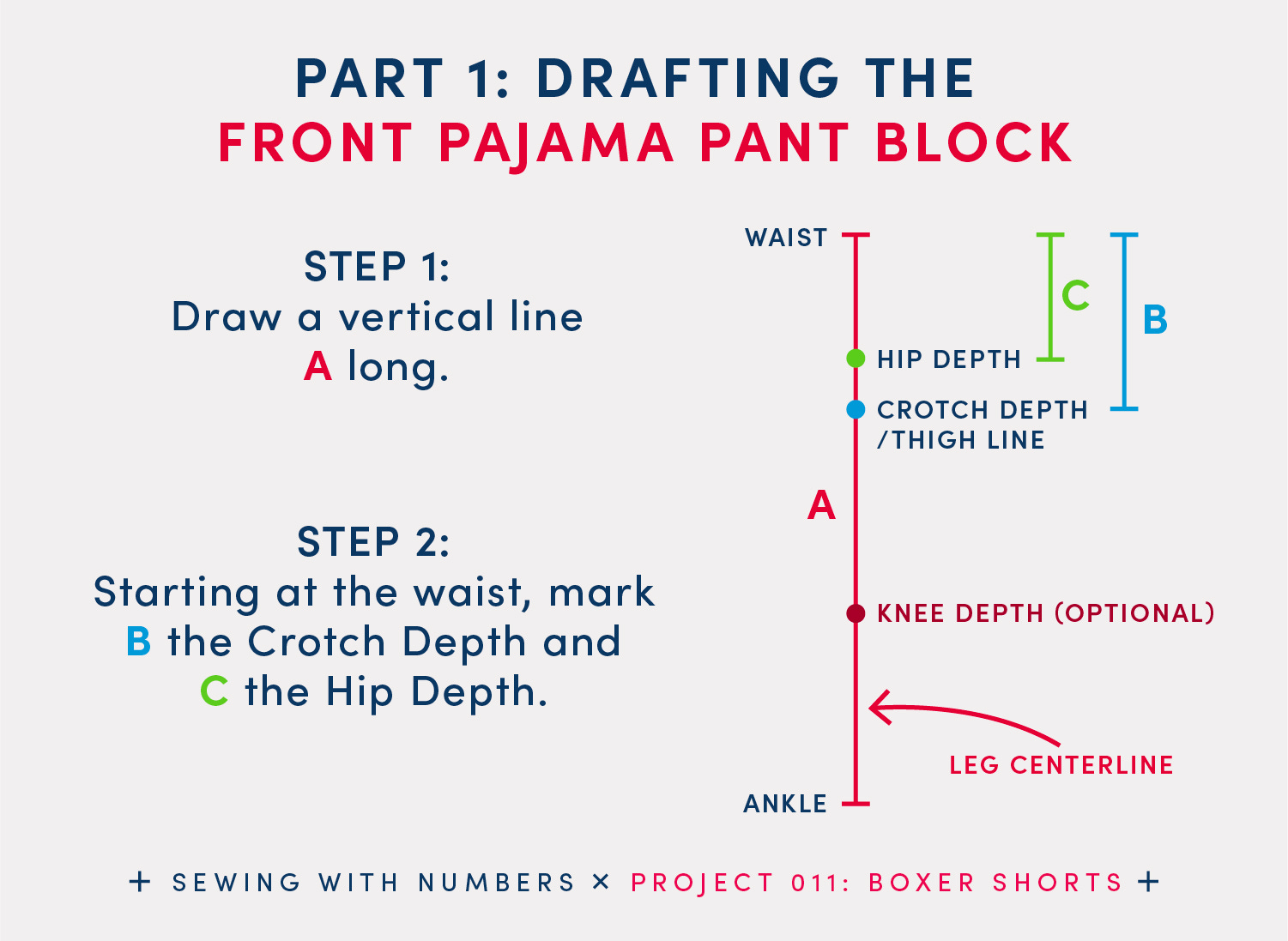
Step 1: Draw a vertical line that is A Waist to Ankle long. This is the Leg Centerline.
Step 2: Starting at the waist, mark B Waist to Crotch, shown with a blue dot. This is the Crotch Depth/Thigh Line. Then mark C Waist to Hip, shown with a green dot. This is the Hip Depth.
NOTE: In the graphic above, I’ve also added the Knee Depth, which is optional for the Pajama style. But, it may be helpful to mark it for fitting purposes and alternate leg styles.
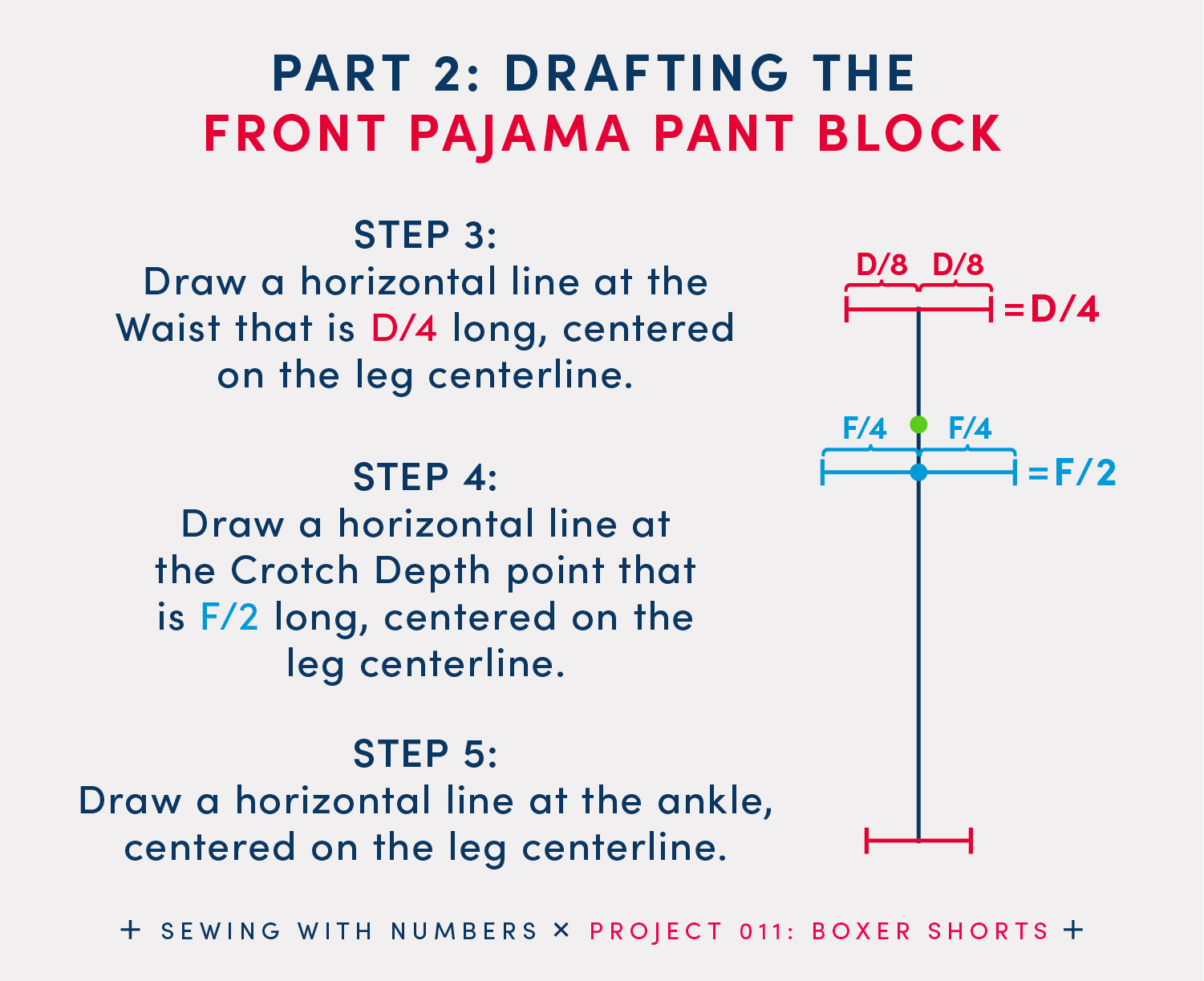
Step 3: Draw a horizontal line at the Waist that is one-fourth D Waist Circumference, or D/4, long and centered on the leg centerline. This is the waist line. We divide by 4 because there are four pattern pieces that make up the waistline. On each side of the Leg Centerline, the waist line will be D/8 long.
Step 4: Draw a horizontal line at the Crotch Depth point that is half of F Thigh Circumference, or F/2 long, and centered on the leg centerline. We divide by 2 because at the thigh, there are two pattern pieces.This is the crotch/thigh line. On each side of the Leg Centerline, the thigh line will be F/4 long.
Step 5: Draw a horizontal line at the ankle, centered on the leg centerline. We’ll be widening this later but for now you can draw it a total of 8” (20cm).
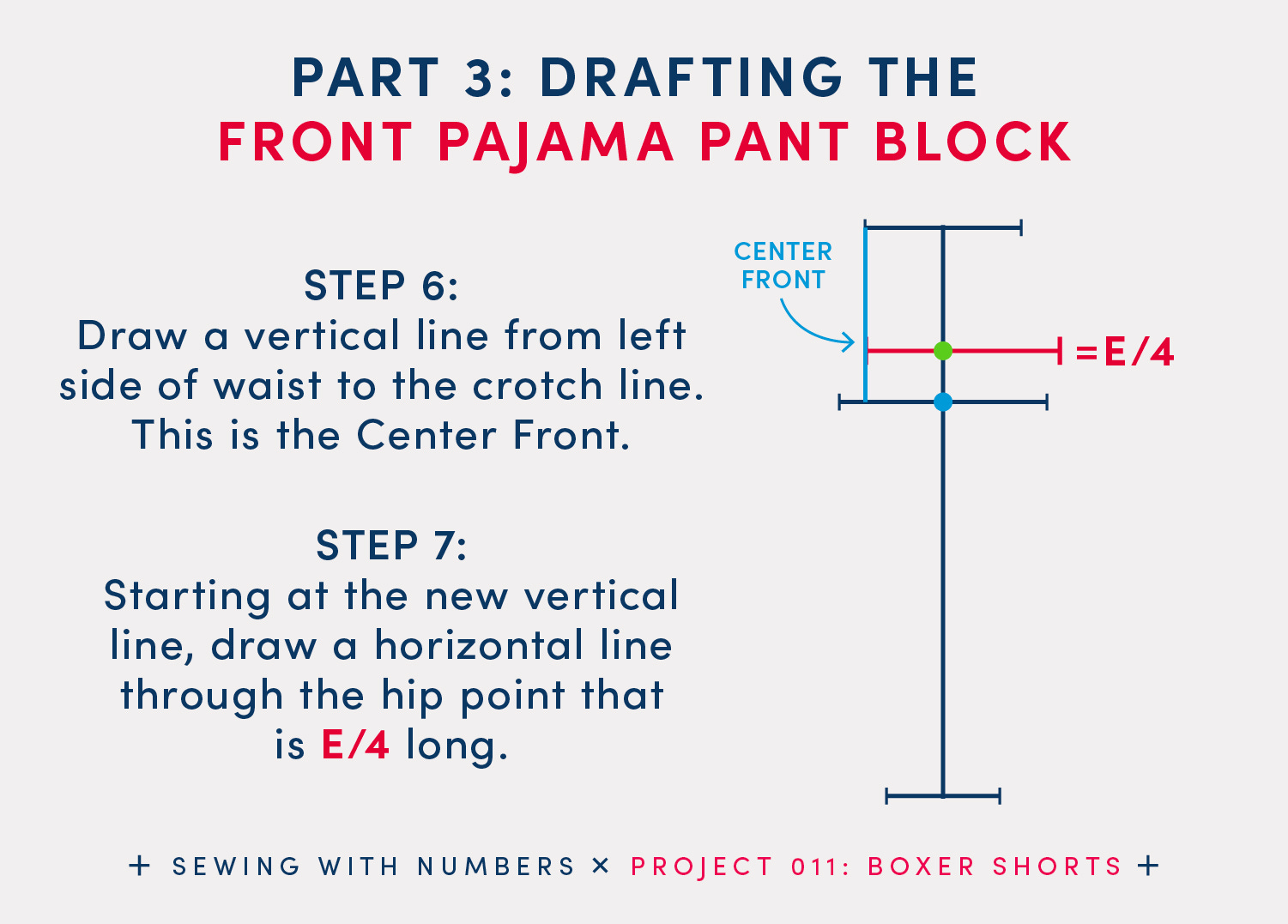
Step 6: Draw a vertical line from the left side of the waist down to the crotch line. This is the Center Front, shown in blue.
Step 7: Starting at the new vertical line/Center Front, draw a horizontal line through the hip point that is one-fourth E Hip Circumference, or E/4, long. Just like with the waist line, we divide the hip measurement by four because when sewn together there are four pattern pieces around the hips.
SPECIAL NOTE: Note that the hip line is not centered on the Leg Centerline. The way I understand it, this is because the pants hang from the waistline. So, we want to build the leg centered with the waist but the hips push out to the sides, so they will be off center from the Leg Centerline. It might help to imagine the Leg Centerline like a piece of string, that is attached at the waist and hanging down to the ankle.

Step 6: Connect the end points of the horizontal lines, curving the lines. On the right side, draw a smooth line for the outseam from the waist point to the hip point, to the thigh point and down to the ankle. To draw the inseam, connect the inner crotch point to the ankle.
Step 7: Next, draw in the crotch curve. Start 2” above the crotch depth and curve down to the crotch line, ending 2” to the left of the center front. In Part 4, we’ll look at the crotch curve more.
Part Three: Draft the Back Pant Block
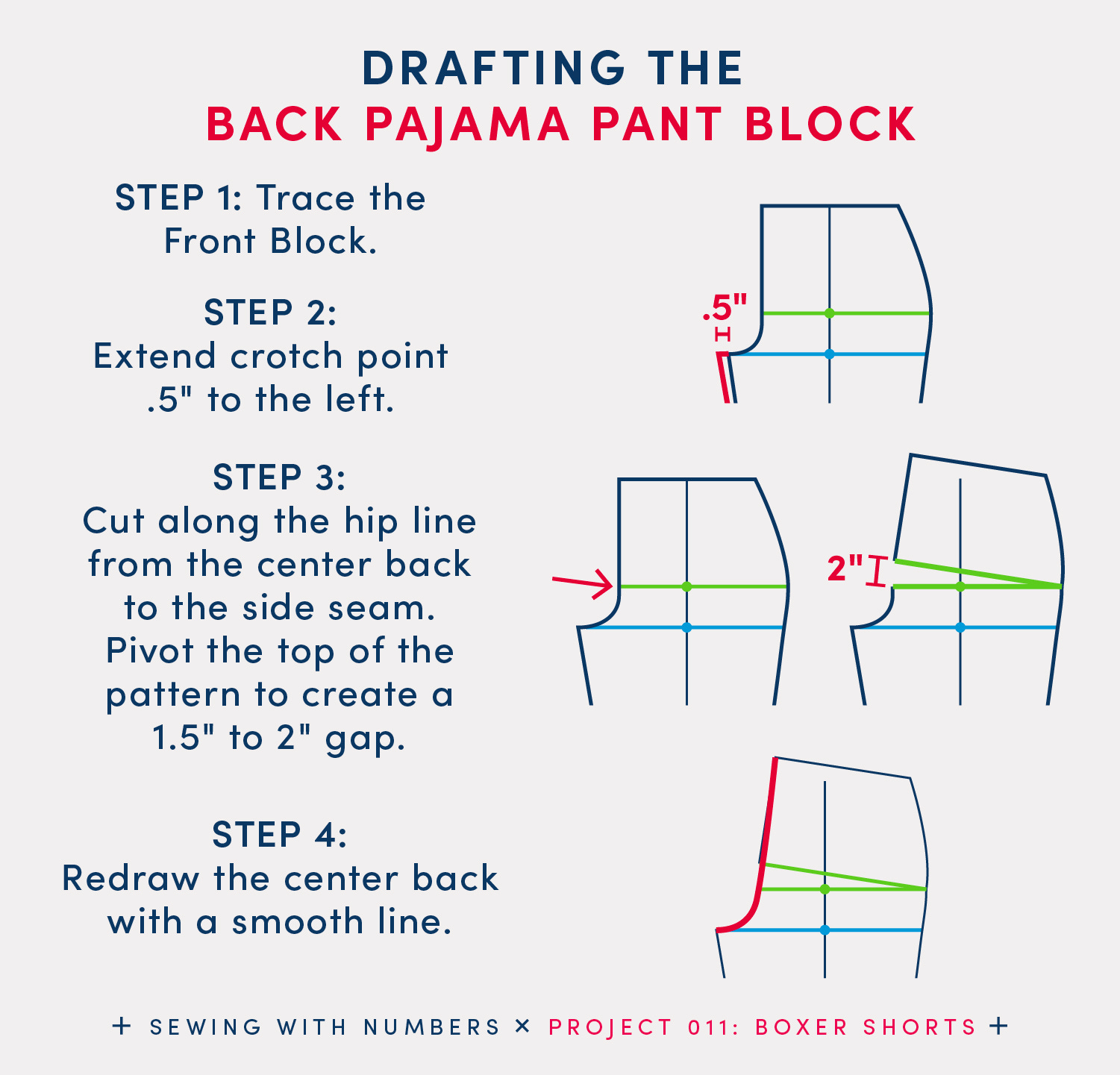
Step 1: Trace the Front Block.
Step 2: Extend crotch point .5” to the left. (In Part 4, we’ll look at the crotch curve more.)
Step 3: Cut along the hip line (shown in green) from the center back to the side seam, leaving a hinge. Pivot the top of the pattern to create a 1.5” to 2” gap at the center back. This adjustment gives more ease of movement for things like sitting and squatting.
Step 4: Redraw the center back with a smooth line.
Part 4: Adjust/Finalize the Block
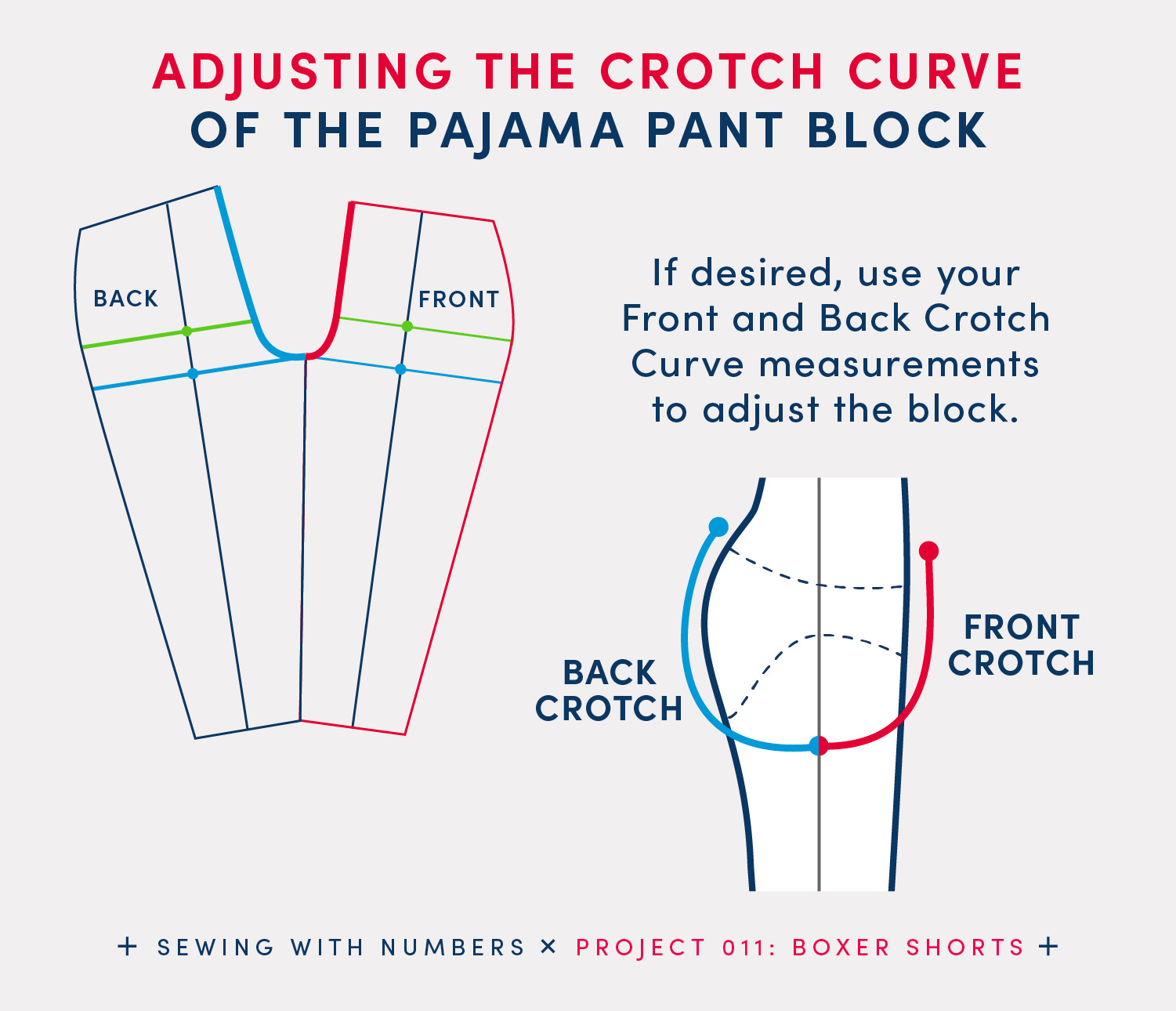
You can proceed with fitting the block as is. Or, you can take measurements of your Front Crotch and Back Crotch curves and compare them to the pattern. We used these measurements when making undies, in this tutorial.
If the measurements of the pattern and the body match up, you’re good to go. I would also leave as is, if the pattern is a little larger. If the pattern measurement is smaller than your body, then I would extend the crotch lines to match your body.
In the McCunn text, they recommend using thick wire (like a coat hanger) to create a model of your personal shape. I think I’ve also seen people use tin foil. It’s a really tricky measurement to take so finding something pliable that retains its shape to copy the curve could be very helpful.

Now that you have the crotch curve sorted. It’s time to add our pattern ease. Because these are a pull-on style with an elastic waist, we need the fabric at the waist to be big enough to go over the hips. The easiest way to ensure this, is to make the finished waist circumference the same as the finished hip circumference.
Step 1: Draw a straight line up from the hip to the waist and connect to the waist point. This is shown in red in the graphic above.
Step 2: Cut along the leg centerline from the waist to the ankle. Spread the pattern pieces one-fourth G Ease at Hip, or G/4, width apart. This creates an equal amount of ease in the front and back.
You may want to distribute the ease unevenly. For example, many blocks have twice as much ease in the back as in the front. In this case, you would add a total of G/3 to the front and 2G/3 to the back. In other words, one third of the ease is added to the front and two thirds is added to the back. Because each pattern piece is half the body, you would add G/6 to the front pattern piece and G/3 to the back pattern piece.
For example, if I want 6” of total ease, I would add 2” total to the front of pants and 4” total to the back. On the pattern pieces, I’d add 1” (6 divided by 6) to the front and 2” (6 divided by 3) to the back.
Step 3: Redraw the line at the waist.
Another option when drafting the blocks is to draft the front and back using separate body measurements for the front and back. I shared a tutorial for this for the Knit Skirt in Project 005, linked below.

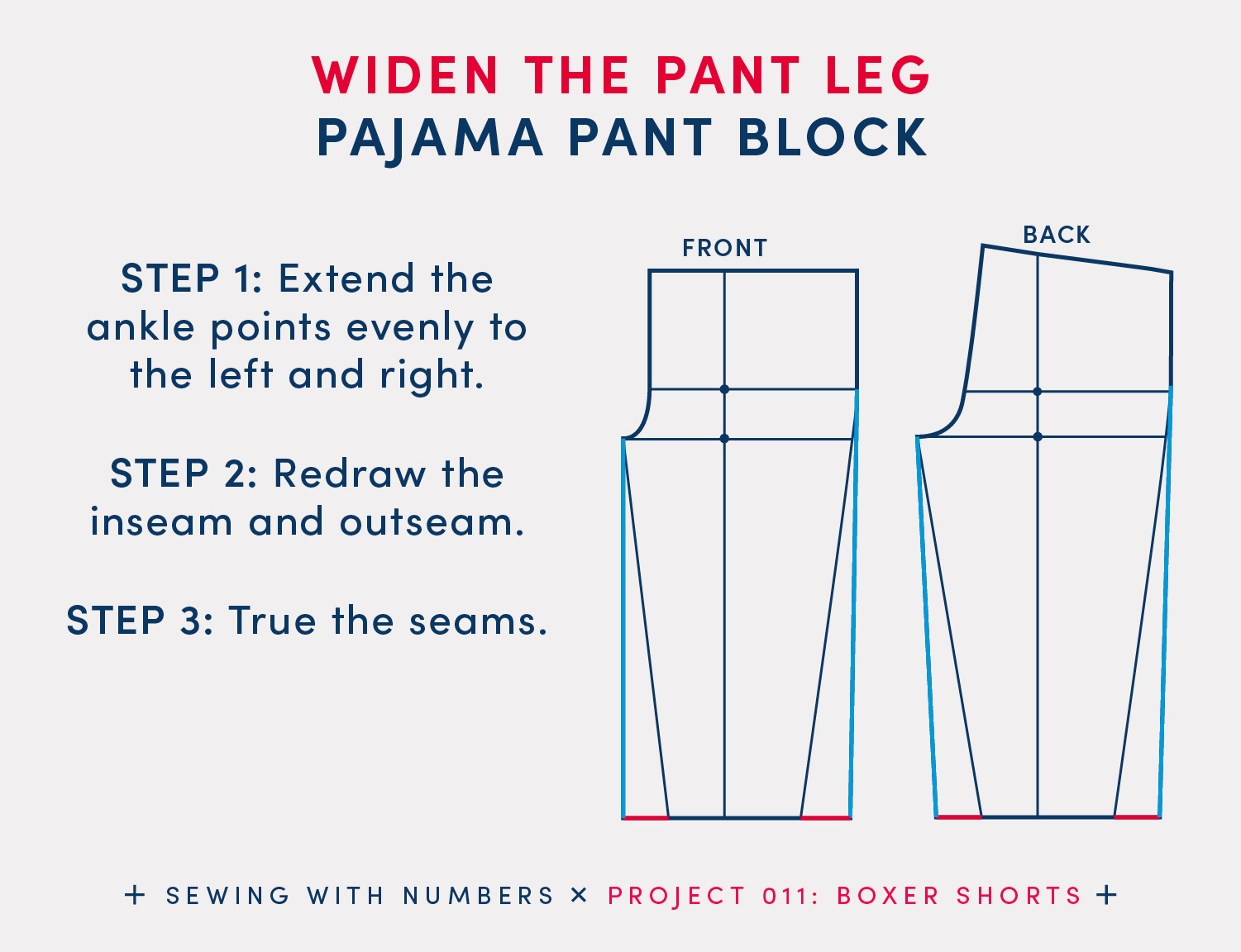
Next, we want to adjust the width of the pant legs. Traditionally, pajama pants have a wider, or slightly narrowed leg. The most important thing is to widen evenly on each side of the Leg Centerline, in order to maintain balance.
Step 1: Extend the ankle points evenly to the left and right. Shown in red above.
Step 2: Redraw the inseam and outseam to connect to the new ankle points. Shown in light blue in the graphic above.
Step 3: Next, you’ll want to true the pattern. True the corners and check that the inseam and outseam lengths are equal. I shared a little about trueing corners in this post from Project 002.
Note, on many patterns the back inseam is about 1/4 inch longer than the front and they are eased together when sewing.
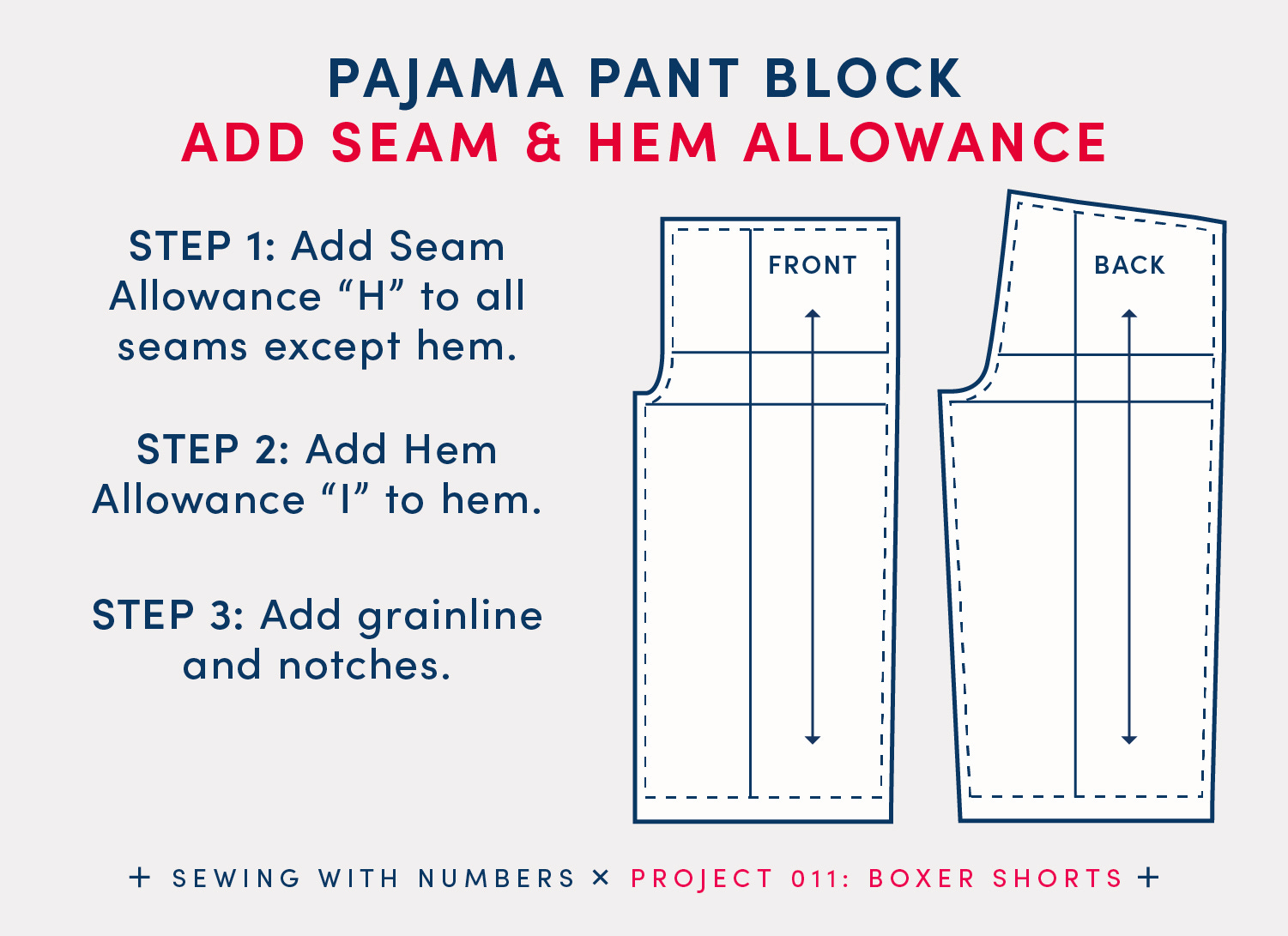
Finally, to test out the pattern, you’ll want to add the Seam Allowance.
Step 1: Add Seam Allowance H to all seams except hem. For fitting purposes, you’ll want at least 5/8” (1.6cm).
Step 2: Add Hem Allowance I to hem. This is only necessary for the final pattern but hem length is something to be aware of during fitting.
Step 3: Add a grainline, parallel to the Leg Centerline. Add notches at the Center Front and Center Back. You can also add notches at the Knee Line. When fitting and testing your muslin, I recommend drawing the Leg Centerline, Hip Line, Thigh Line and Knee Line on your fabric.
Resources
I consulted the following pattern drafting books for this tutorial: (links are affiliate links to my Bookshop)
If you want to learn more about using Balance Lines for fitting, I recommend checking out the blog Handmade PhD and this video from Katrina Kay.
If you want to draft a waistband for your pajama pants, check out my tutorial from Project 001.
I hope that you enjoyed this tutorial. Please let me know in the comments if you have any questions. Next week, I’ll show how to adapt this block into boxers shorts with a fly front.
There are lots of ways to support this free content. You can tap the “heart” at the top or bottom, share or “restack” the post to help other people find it. Become a paid subscriber or, visit one of the links below.
Sewing With Numbers Drafting Manuals are now available for purchase.
Pattern Shop | Improv Quilting E-Course | Donate at Ko-Fi | YouTube
Happy mathing!
Beth
I love this tutorial. My lower tummy is a couple inches bigger than my waist. I want the pants to be at the waistline. Where in the pattern should I allow for the extra below-waistline inches? I don’t want the pants to look too baggy from waist to hip. Thank you!
Thanks for this tutorial Beth. It's Labour Weekend here in Aotearoa NZ and I'm going to spend it drafting my block.