
Project 013: How to draft a partial placket
In this exercise, I'm sharing two different ways to draft a partial placket. Plus, there's a free printable pdf to practice folding the placket.

Welcome to Sewing With Numbers, a newsletter about sewing, math, design and how to draft your own sewing patterns. Through simple pattern drafting exercises, I’ll show you how fun, useful and empowering math can be. ✂️ Posts older than 3 months are archived for paid subscribers. But if subscriptions aren’t your thing, I also have PDF Booklets for older projects in my shop.
Hello my mathy friends! I hope that you are doing well. I’ve had a busy last few weeks with lots of travel and work. On the sewing side of things, I’m getting ready to test a pattern for this bucket tote and I’m putting the finishing touches on the pdf manual for Project 11. Lots of stuff happening in the studio lately!
In this installment of Project 13, we’re going to be exploring how to draft two styles of the partial placket—a simpler two piece pattern and a more advanced one-piece pattern. I think plackets can be tricky to work with so I’ve made a printable pdf that you can use to practice folding the one-piece placket, plus a video to show you how it works. Let’s get started!
Last week, I showed how to draft plackets that run the full length of a seam and today we’ll be drafting plackets that are inserted into a garment. This style of placket is commonly found at the end of a sleeve or in the top part of a shirt. When folded, the placket pattern piece covers the raw edges of the opening and “replaces” the opening, with one placket directly on top of the other. If desired, you can add buttons or snaps to the placket.
The construction is similar to a welt pocket (or zipper) in that you cut into the fabric part way and fold it back to create the finished edge. It’s definitely more complicated than a full length placket but with some practice and patience, it’s not too hard to sew.
If you need to catch up on any previous posts, links are below.
RELATED READING


Notes for drafting partial plackets
In both of the drafting examples below, we’ll be using the same letters throughout the formulas. When drafting your own placket, you can enter the dimensions of your choosing.
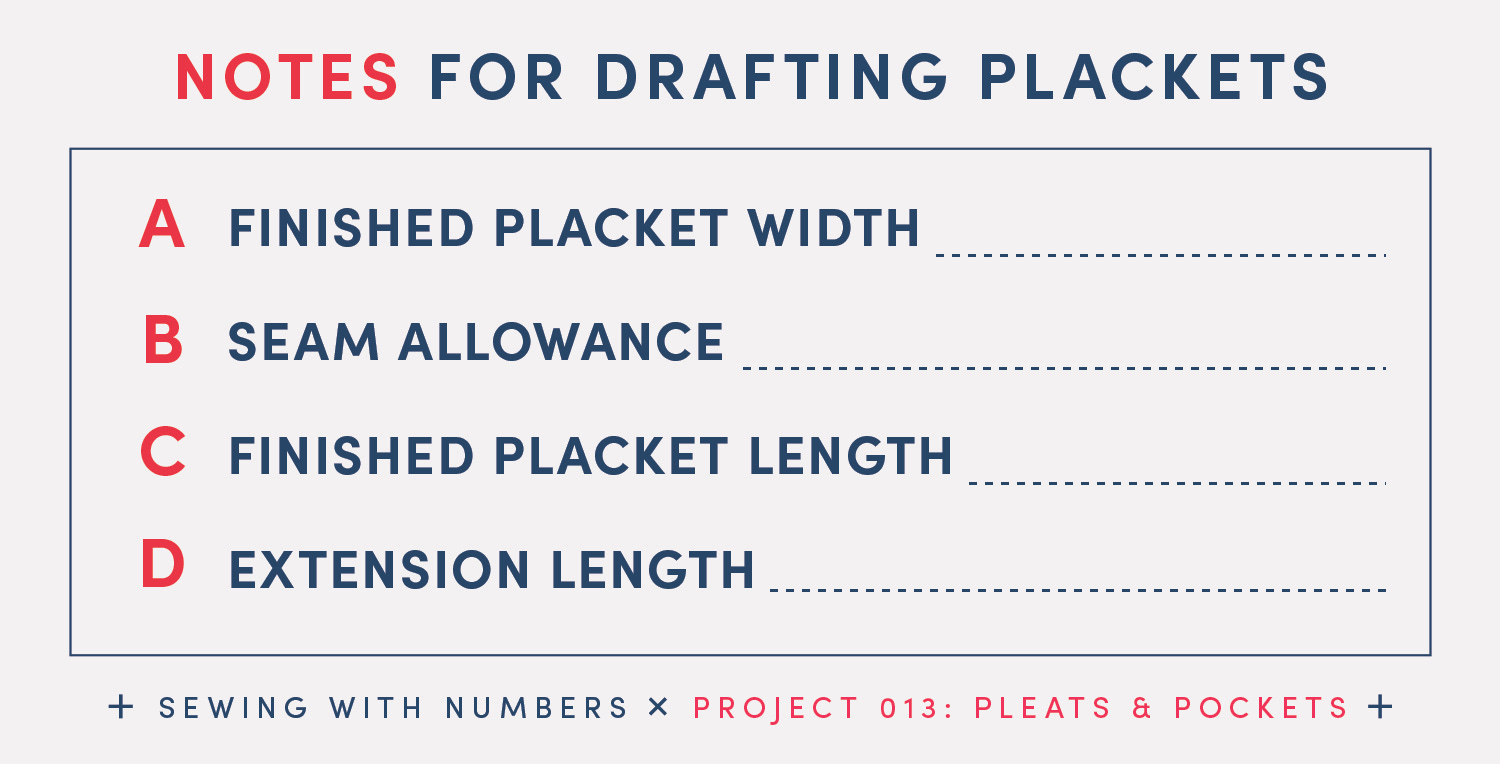
A Finished Placket Width This is how wide you want the finished width to be and is often determined by the width of the button or snap.
B Seam Allowance Maker's choice!
C Finished Placket Length This is the finished length of the placket opening. For example, if you’re making a button down shirt, the center front of the shirt from the neck to the hem equals the finished placket length.
D Extension Length This extension is used to cover the raw ends of the placket (at the bottom side). Depending on how you sew the placket, this extension can be either on the wrong or the right side of the garment. If you want to topstitch this extension on the right side of the garment, you could make the extension equal to A, so there is a square at the bottom. But, you can make it as long as you like.
Example 1: How to Draft a Two-Piece Partial Placket
The two-piece partial placket is the easiest to draft because it’s just a rectangle with folds. The pattern piece is folded in a similar way to double fold bias tape. One placket is stitched to each side of the opening and then folded into place to cover the raw edges.
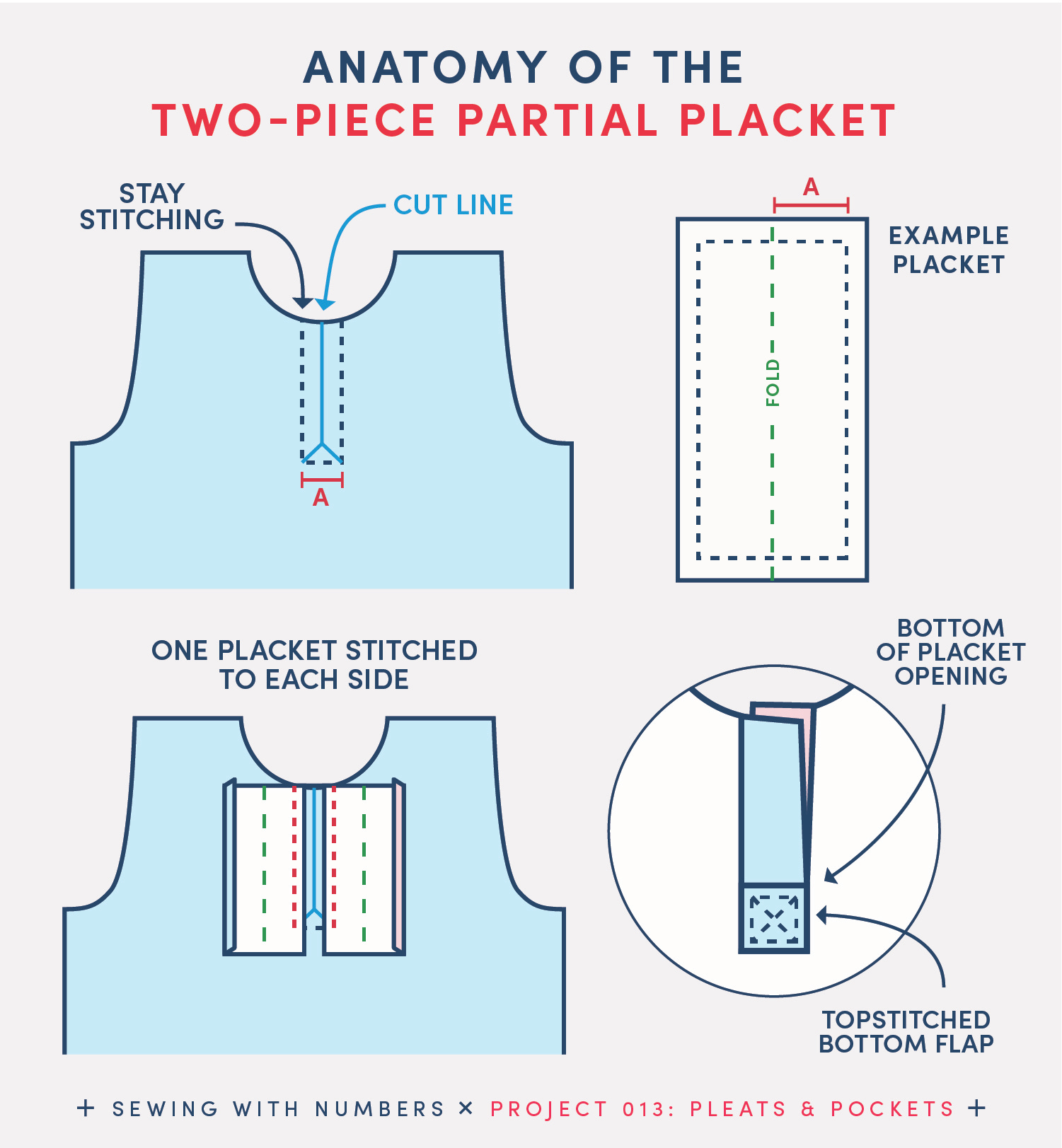
Above are illustrations for how the two-piece placket is constructed. In the top left, you can see the example garment with the placket opening marked at the center. The placket should be longer than the placket opening so that the ends can be finished.
In the lower left, you can see how the plackets are stitched to the garment. The dashed red line is the stitching line. If the placket is stitched to the right side, the extension can be folded inside and hidden. If the placket is stitched to the wrong side, the extension can be folded to the outside of the garment and topstitched as a decorative element.
In the lower right of the graphic above, you can see the finished placket folded so that one piece is on top of the other.
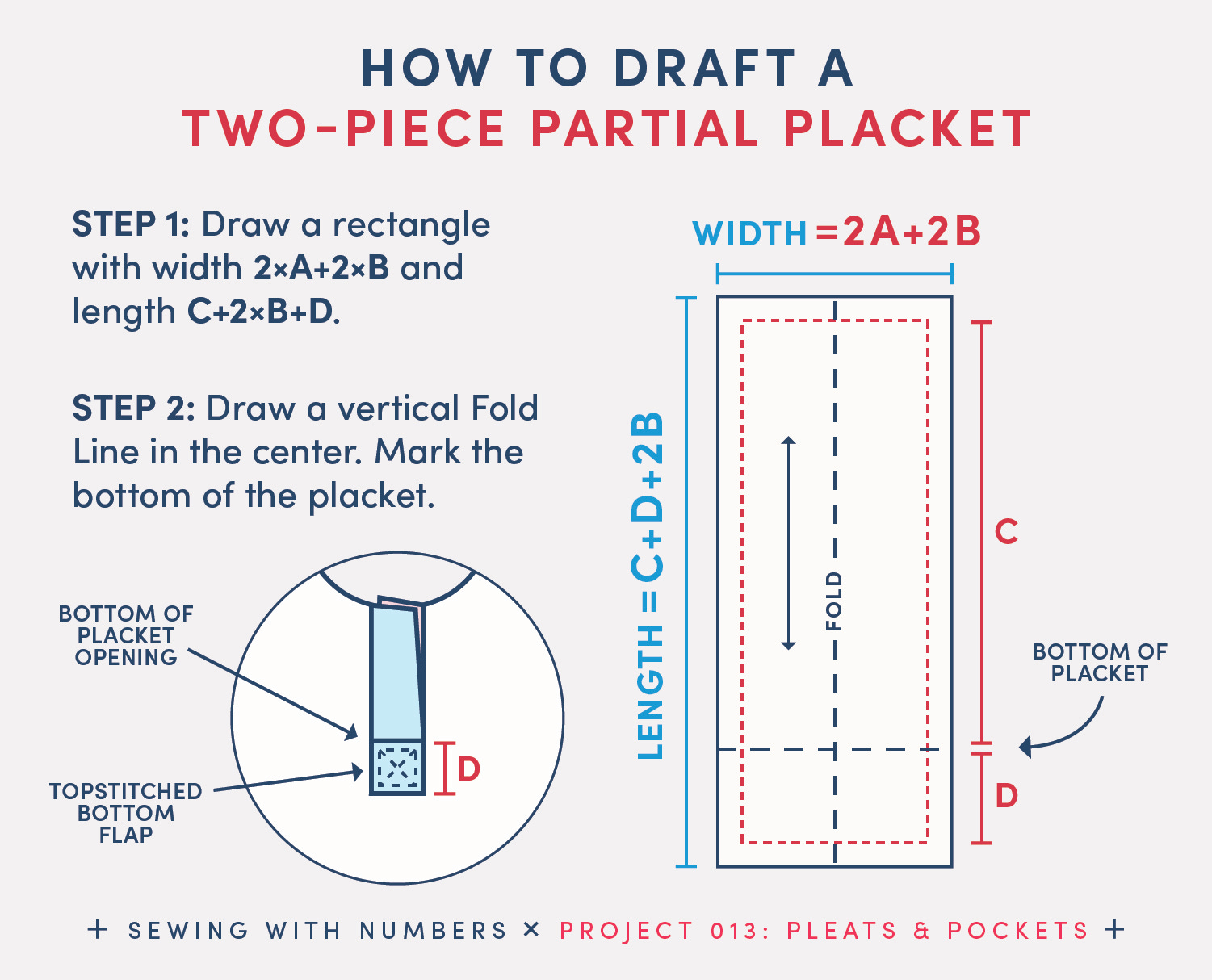
STEP 1: Draw a rectangle with width two times the Placket Width A plus two times the Seam Allowance B and length Finished Placket Length C plus Extension Length D plus two time Seam Allowance B. In math terms, the width is 2×A+2×B and the length is C+D+2×B.
STEP 2: Draw a vertical Fold Line in the center of the pattern piece. Mark the bottom of the placket D+B from the bottom.
If you want more info on how to sew partial plackets, check out these tutorials from Megan Nielsen: Three Ways to Sew a Partial Placket .
Example 2: How to Draft a Single Piece Partial Placket
If you’ve ever sewn a button down shirt, it’s likely that you’ve sewn a placket like this before at the sleeves. This pattern piece kind of feels like magic or origami with how many folds it has. It functions the same way as the two-piece placket but it is also sewn to the bottom end of the placket opening.
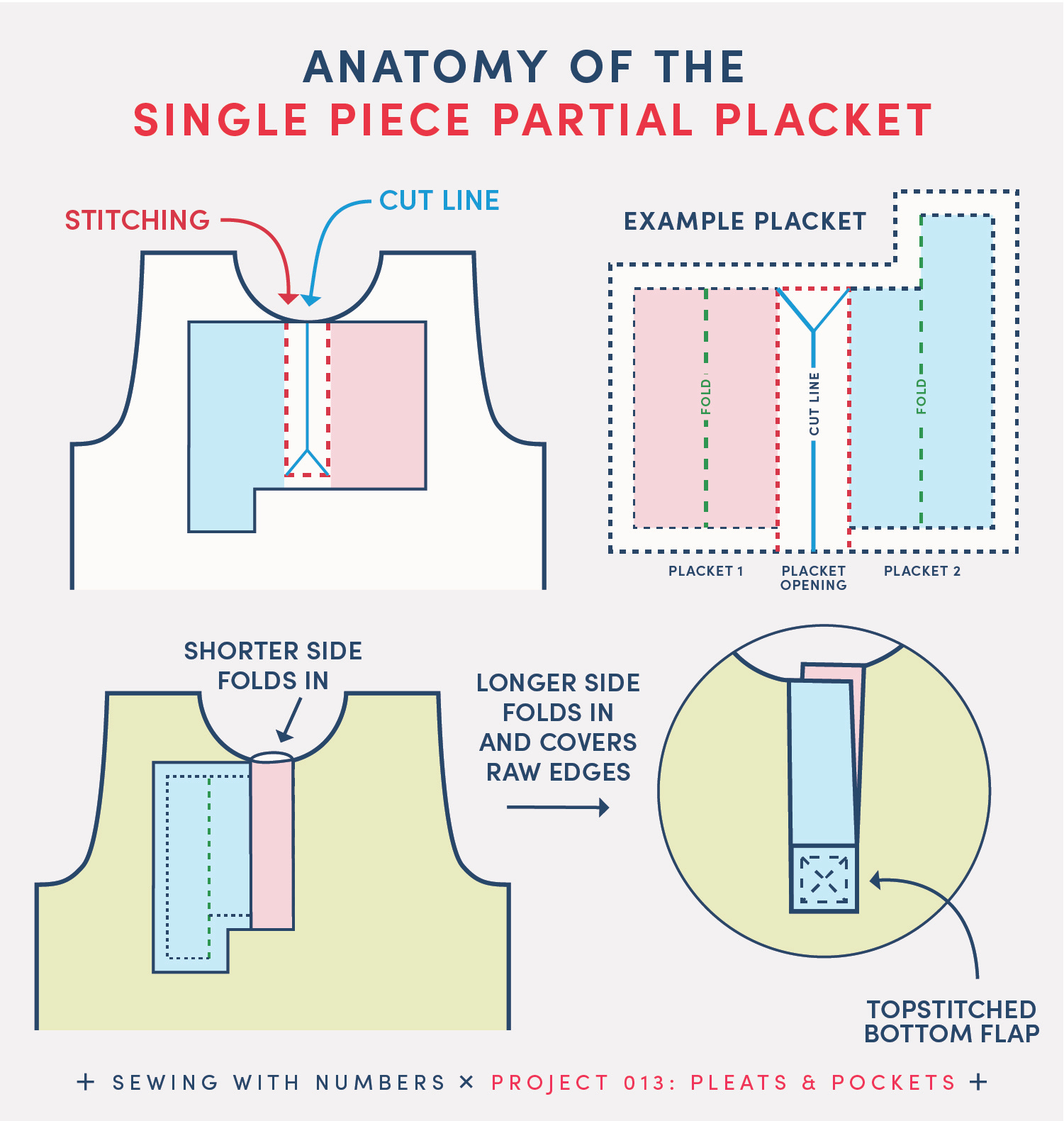
Above are illustrations to show how the one-piece placket works. The center of the placket pattern piece matches the placket opening and each side becomes one placket. I’ve colored one side blue and one side pink. This placket is attached to the garment by stitching around all three sides of the placket opening. Then the center of the placket opening is cut along the blue lines in a Y-shape. After that, the placket can be folded into place and topstitched.
I found it helpful to practice folding the pattern piece to really understand how it works. Below is a pdf that you can download, cut out and practice folding. For extra guidance, watch the video.

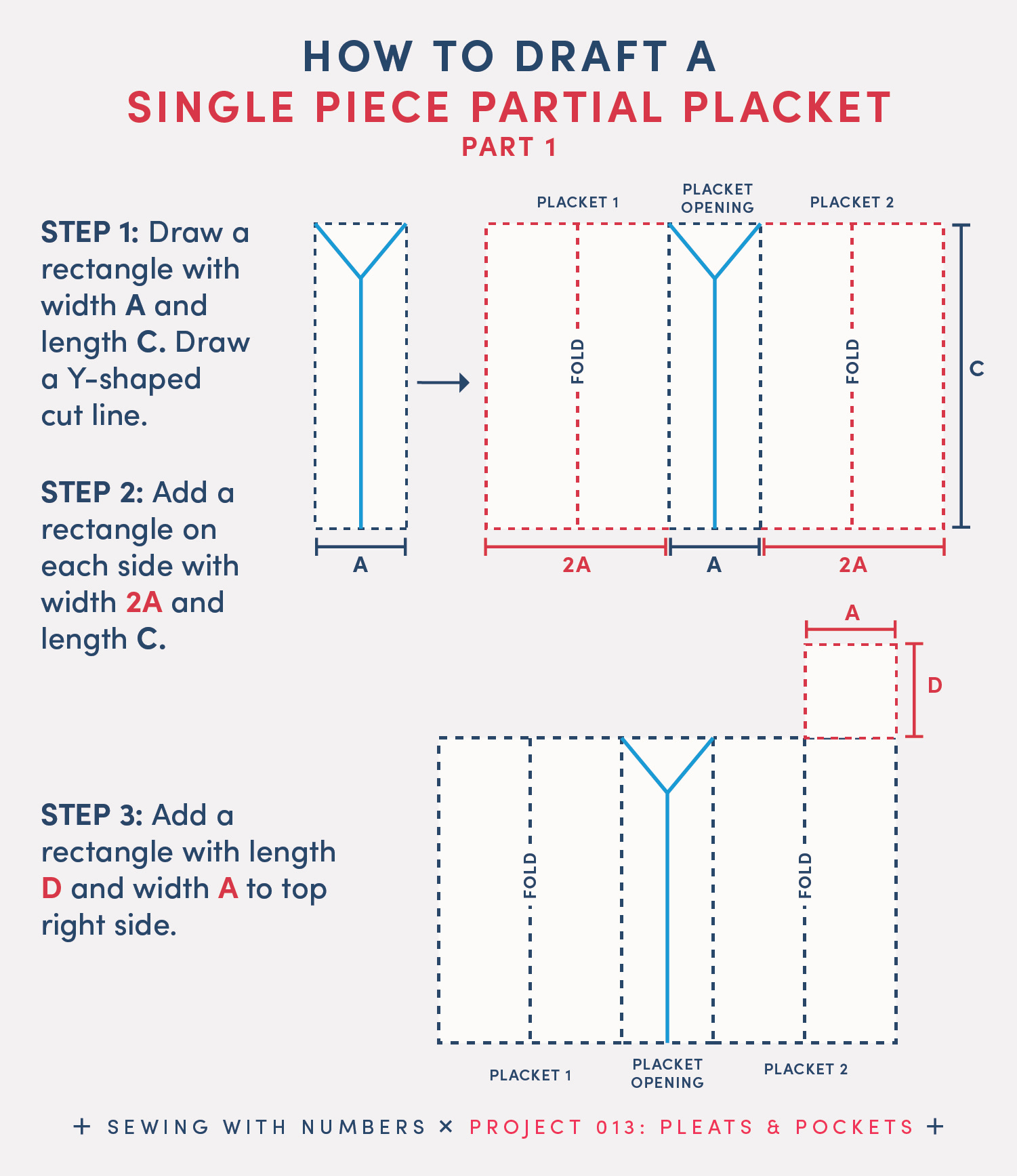
STEP 1: Draw a rectangle with width Finished Placket Width A and length Finished Placket Length C. Draw a Y-shaped cut line in the center. The top of the Y is the end of the placket. The bottom of the Y is the seam that gets attached to a cuff or collar.
STEP 2: Add a rectangle on each side with width two times Finished Placket Width A and length Finished Placket Length C. In short, the added rectangles are 2×A by C.
STEP 3: Add a rectangle with length Extension Length D and width Finished Placket Width A to the top right side. If you want to create a triangle “tower” at the top of the placket, draw this rectangle as a triangle with the point at the top.
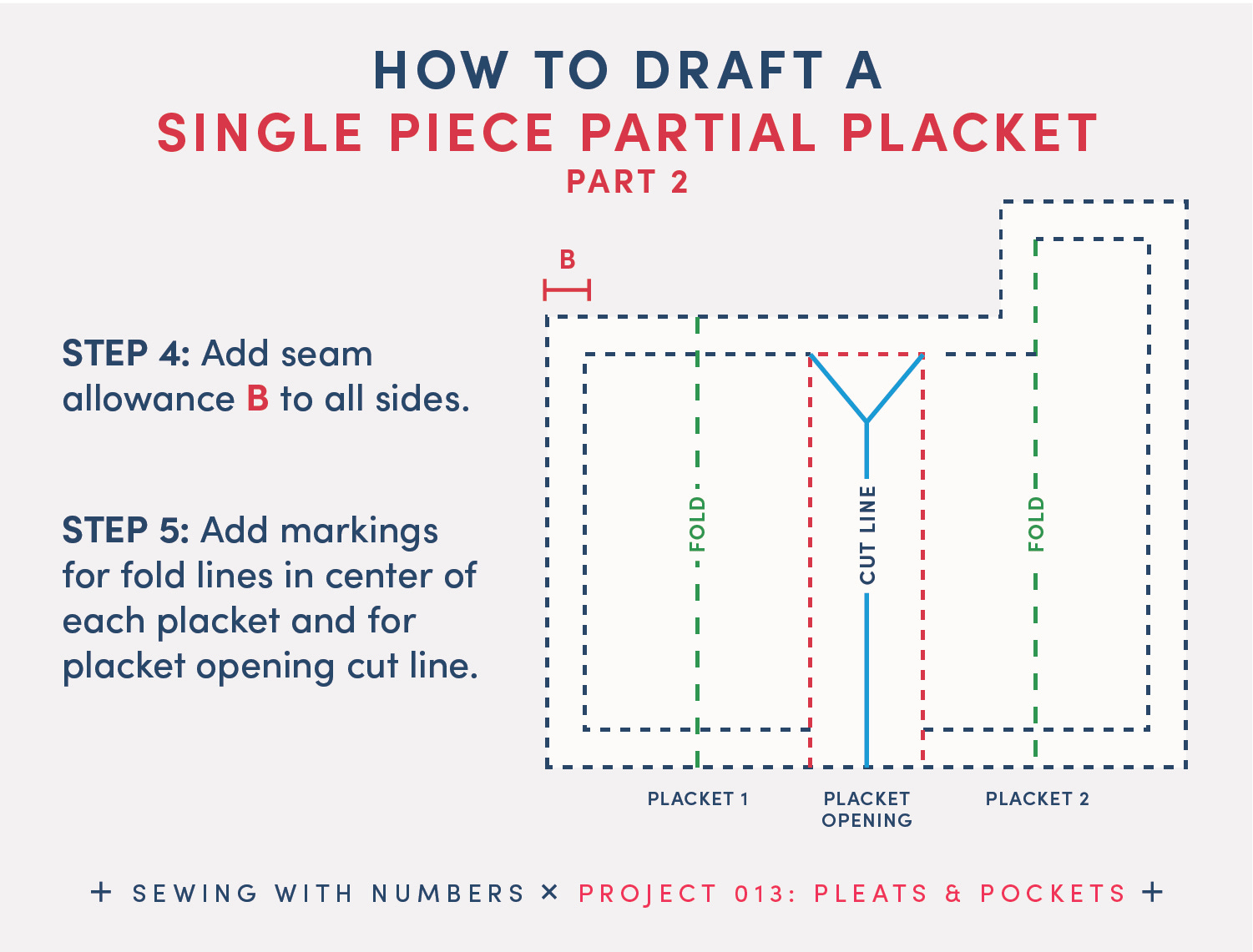
STEP 4: Add Seam Allowance B to all sides.
STEP 5: Add markings for the fold lines in the center of each placket (shown in green).
If you want more info on how to sew this style of placket, check out this post from The Fabric Store.
That’s all for today! I hope that you enjoyed this post. For the final section of this series, we’ll be drafting pockets. Please let me know in the comments if you have any questions.
There are lots of ways to support this free content. You can tap the “heart” at the top or bottom, share or “restack” the post to help other people find it. Become a paid subscriber or, visit one of the links below.
Sewing With Numbers Drafting Manuals are now available for purchase.
Pattern Shop | Improv Quilting E-Course | Ko-Fi | YouTube
Happy mathing!
Beth
